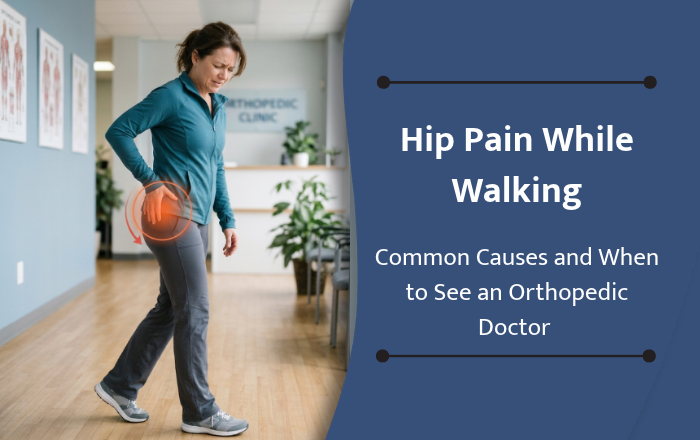
Hip pain while walking is common, and it is easy to dismiss at first. Sometimes it follows a long day on your feet and settles with rest. At other times it returns with every walk, starts to limit your day or wakes you at night. The hip is a large ball-and-socket joint that carries your body weight with each step, so a problem in the joint, in the tissues around it or even in the lower back can show up as pain while you walk.
This guide explains the common causes of hip pain while walking, what the location of the pain can suggest, the warning signs that call for a prompt check-up and how an orthopedic doctor finds the cause.
Why Does the Hip Hurt When You Walk?
Each step puts several times your body weight through the hip. If the cartilage is worn, a tendon is irritated, a muscle is strained or a nerve is pinched, that load can bring on pain. Where you feel it often gives a first clue:
- Groin or front of the hip: often linked to the hip joint itself.
- Outer side of the hip: often linked to the tendons and bursa on the side of the hip.
- Buttock or back of the hip: may come from the muscles, the sacroiliac joint or the lower spine.
- Pain travelling down the thigh or leg: may point to a nerve in the back.
This is only a guide. Hip pain can be felt in the knee, and a back problem can be felt in the hip. A clinical examination is needed to know the source.
Common Causes of Hip Pain While Walking
1. Osteoarthritis of the Hip
Osteoarthritis is a gradual wearing of the cartilage that cushions the joint. It usually causes a deep ache in the groin or thigh that is worse when walking, climbing stairs or getting up after sitting. Morning stiffness and a reduced range of movement are common. You can read more in our article on joint pain, its causes and how to manage it.
2. Trochanteric Bursitis and Tendon Problems
A bursa is a small fluid-filled cushion that reduces friction between tendons and bone. When the bursa or the tendons of the buttock muscles are irritated, pain is felt on the outer side of the hip. It is often tender to touch and may be worse when lying on that side at night or after walking for a while.
3. Labral Tear and Femoroacetabular Impingement
The labrum is a ring of soft tissue around the hip socket. A tear can cause catching, clicking or a pinching pain in the groin, especially when twisting or turning. Femoroacetabular impingement is a condition where the shape of the ball and socket causes the bones to rub against each other during movement, and it can be linked to labral damage. Both are more often seen in younger and active people.
4. Avascular Necrosis
In avascular necrosis, the blood supply to part of the thigh bone head is reduced, and the bone can weaken over time. Long-term steroid use, heavy alcohol use and some past injuries are known risk factors. This condition needs a medical assessment, because early diagnosis helps guide the choice of treatment.
5. Stress Fracture or Fracture
A small crack in the neck of the thigh bone can cause pain on walking that settles with rest. It may occur with repeated overuse or when bones are weak, as in osteoporosis. A fall followed by severe hip pain, or an inability to put weight on the leg, can mean a fracture and needs urgent medical attention.
6. Pain Referred from the Lower Back
Nerves from the lower spine supply the buttock, hip and leg. A pinched nerve or a disc problem can cause pain in the hip or buttock that may spread down the leg, with tingling or numbness in some people. Our guide on how to manage sciatica pain explains this in more detail.
7. Other Causes
Inflammatory arthritis, sacroiliac joint pain, joint infection, a groin hernia and some conditions in children can also cause hip pain. Some of these are not orthopedic problems at all, which is why an examination matters.
Warning Signs: When to See an Orthopedic Doctor
Mild pain after unusual activity may settle in a few days with rest. You should see an orthopedic doctor if you notice any of the following:
- Pain that lasts more than a few weeks or keeps coming back
- Pain that wakes you at night or is present even at rest
- A limp, or pain that limits walking, climbing stairs or putting on socks and shoes
- Pain after a fall or injury
- Swelling, warmth or redness around the hip
Get Urgent Medical Help If
- You cannot stand or put weight on the leg after a fall or injury
- The leg looks shortened or turned out, or the hip looks out of shape
- You have severe hip pain with fever, chills or a hot, swollen joint
- You have weakness in the leg, numbness around the groin or buttocks, or a change in bladder or bowel control
How an Orthopedic Doctor Finds the Cause
Diagnosis usually follows a few steps:
- History: when the pain began, where it is, what makes it worse or better, and any past injuries, illnesses or medicines.
- Physical examination: checking how you walk, the range of movement in the hip, tender spots, muscle strength and the lower back.
- X-ray: shows the bone and the joint space, and can show arthritis, some fractures and the shape of the joint.
- MRI or CT scan: may be advised to look at soft tissue, the labrum, early bone changes or the spine.
- Blood tests: may be advised when infection or inflammatory arthritis is suspected.
Treatment Depends on the Cause
There is no single treatment for hip pain while walking, because the causes differ. The options your doctor may discuss include:
- Rest from the activity that causes pain and a gradual return to normal activity
- Physiotherapy to improve strength and movement
- Medicines, taken only as advised by your doctor
- Injections in selected cases
- Surgery for some conditions, when other measures are not enough. You can read about the usual considerations in signs you might need a hip replacement.
The plan is chosen after examination and tests, and outcomes vary from person to person.
Frequently Asked Questions
1. Is hip pain while walking always a sign of arthritis?
No. Arthritis is one cause, but muscle strain, bursitis, tendon problems, a labral tear or a pinched nerve in the back can cause similar pain. An examination and, if needed, imaging help find the cause.
2. Should I keep walking if my hip hurts?
Mild pain after unusual activity may settle with rest, but pain that keeps coming back, causes a limp or does not settle should be checked. Do not walk on a leg that cannot bear weight after a fall.
3. Can a back problem cause hip pain?
Yes. A pinched nerve or disc problem in the lower back can cause pain in the buttock and hip, sometimes with tingling in the leg.
4. Do I need surgery for hip pain?
Not in most cases. Many causes are first managed with rest, physiotherapy and other non-surgical measures. Surgery is considered only for some conditions, after your doctor has examined you and reviewed your tests.
Consult an Orthopedic Surgeon in Magarpatta, Hadapsar, Pune
If hip pain is affecting your walking, Dr. Parimal Kore, Orthopedic Surgeon and Joint Replacement Specialist, MBBS, DNB (Orthopedics), with 17+ years of experience, can examine you and advise on the next steps. He is the Managing Director of Racemous Polyclinics in Magarpatta.
Name: Dr. Parimal Kore | Orthopedic Surgeon in Magarpatta
Address: Racemous Polyclinic, Marvel Fuego, 5150, Magarpatta Rd, above Kwality Restaurant, Amanora Park Town, Hadapsar, Pune, Maharashtra 411036
Phone: 99881 13030
This article is for general information and does not replace a medical consultation.